
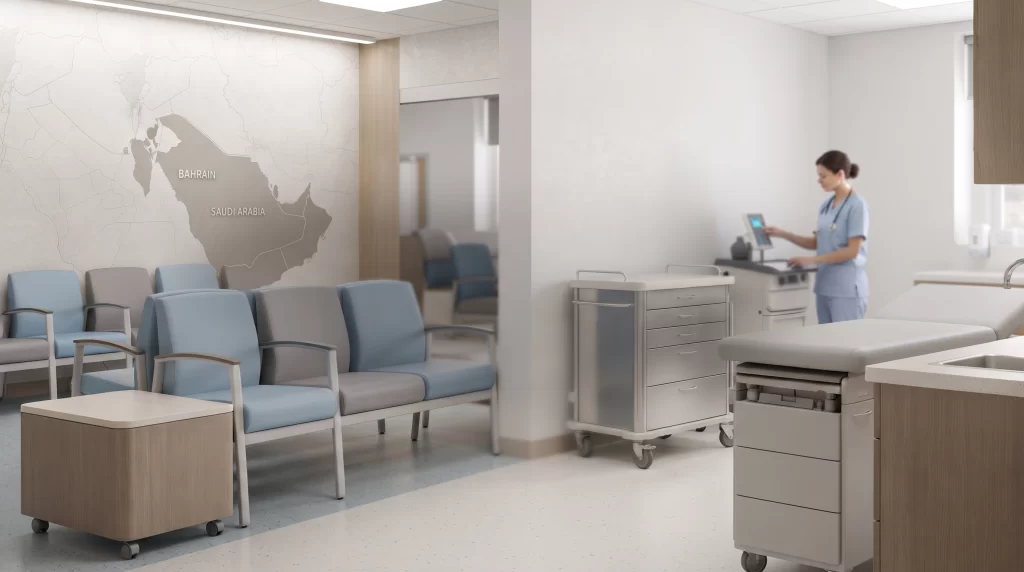
Wood Works in Hospitals and Clinics
Designing and manufacturing hospital furniture for healthcare facilities in Saudi Arabia and Bahrain requires strict adherence to regional medical standards, including Saudi Arabia’s CBAHI (Central Board for Accreditation of Healthcare Institutions) and SFDA (Saudi Food and Drug Authority), as well as Bahrain’s NHRA (National Health Regulatory Authority). Beyond aesthetics, furniture in the GCC must endure a demanding climate of high heat and humidity while withstanding aggressive, hospital-grade chemical disinfectants and non-stop use. As the healthcare sector expands rapidly under initiatives like Saudi Vision 2030, procurement managers and hospital designers rely on manufacturers to deliver furniture that guarantees infection control, bariatric safety, and ergonomic comfort. Here is a comprehensive breakdown of the core materials and specialized furniture types required for modern Middle Eastern healthcare facilities. Designing and manufacturing hospital furniture for healthcare facilities in Saudi Arabia and Bahrain requires strict adherence to regional medical standards, including Saudi Arabia’s CBAHI (Central Board for Accreditation of Healthcare Institutions) and SFDA (Saudi Food and Drug Authority), as well as Bahrain’s NHRA (National Health Regulatory Authority).Beyond aesthetics, furniture in the GCC must endure a demanding climate of high heat and humidity while withstanding aggressive, hospital-grade chemical disinfectants and non-stop use. As the healthcare sector expands rapidly under initiatives like Saudi Vision 2030, procurement managers and hospital designers rely on manufacturers to deliver furniture that guarantees infection control, bariatric safety, and ergonomic comfort. Here is a comprehensive breakdown of the core materials and specialized furniture types required for modern Middle Eastern healthcare facilities. 1. Decoration & Waiting Area Furniture Hospital waiting areas, reception zones, and patient lounges are the first point of contact. This furniture must seamlessly blend welcoming, modern aesthetics with rigorous clinical cleanability. Requirements: High traffic demands seating with extreme tear resistance, zero porosity, and structural frames that accommodate bariatric weight capacities. Key Materials Used: 2. Patient Room & Utility Furniture Patient room furniture takes the most direct abuse from medical equipment, food spills, and rigorous sanitization. This category includes overbed tables, bedside cabinets, and patient wardrobes. Requirements: Surfaces must be completely moisture-proof, impact-resistant, and feature safe, rounded edges to prevent patient injury. Key Materials Used: 3. Specialized Clinical Furniture This category is completely exclusive to the functional delivery of healthcare. It includes crash carts, IV poles, medical trolleys, scrub sinks, and examination tables. Requirements: Absolute sterility, heavy load capacity, corrosion resistance, and mobility. Key Materials Used: Hospital Furniture Material Comparison For procurement managers aiming to meet strict GCC healthcare mandates, choosing the right surface and fabric is critical for passing inspections and reducing long-term replacement costs. Material Primary Hospital Application Key Advantages Maintenance & Durability Medical-Grade Vinyl Waiting room seating, exam tables Impermeable, high chemical resistance, antimicrobial Withstands daily bleach exposure; 500,000+ double rubs Compact Laminate Overbed tables, wet-area panels Extreme impact resistance, 100% moisture-proof Will not swell in high humidity; easily wiped clean Solid Surface (SMS) Nurse stations, surgical sinks Seamless, zero-porosity, mold-resistant Scratches can be buffed out; lifelong durability Stainless Steel 304/316 IV poles, crash carts, trays Rust-proof, extreme structural capacity Withstands industrial sterilization; practically indestructible Healthcare Polyurethane Lounge chairs, long-term seating Softer feel, breathable, antimicrobial Easy to clean; resists cracking better than lower-grade PVC By manufacturing with these verified, medical-grade materials, furniture suppliers can guarantee that facilities in Saudi Arabia and Bahrain not only pass strict CBAHI and NHRA audits but also provide a safe, healing environment for patients and a highly functional workspace for medical staff.